Wednesday, June 26, 2013

Let the rivers clap their hands, Let the mountains sing together for joy; Psalm 98:8


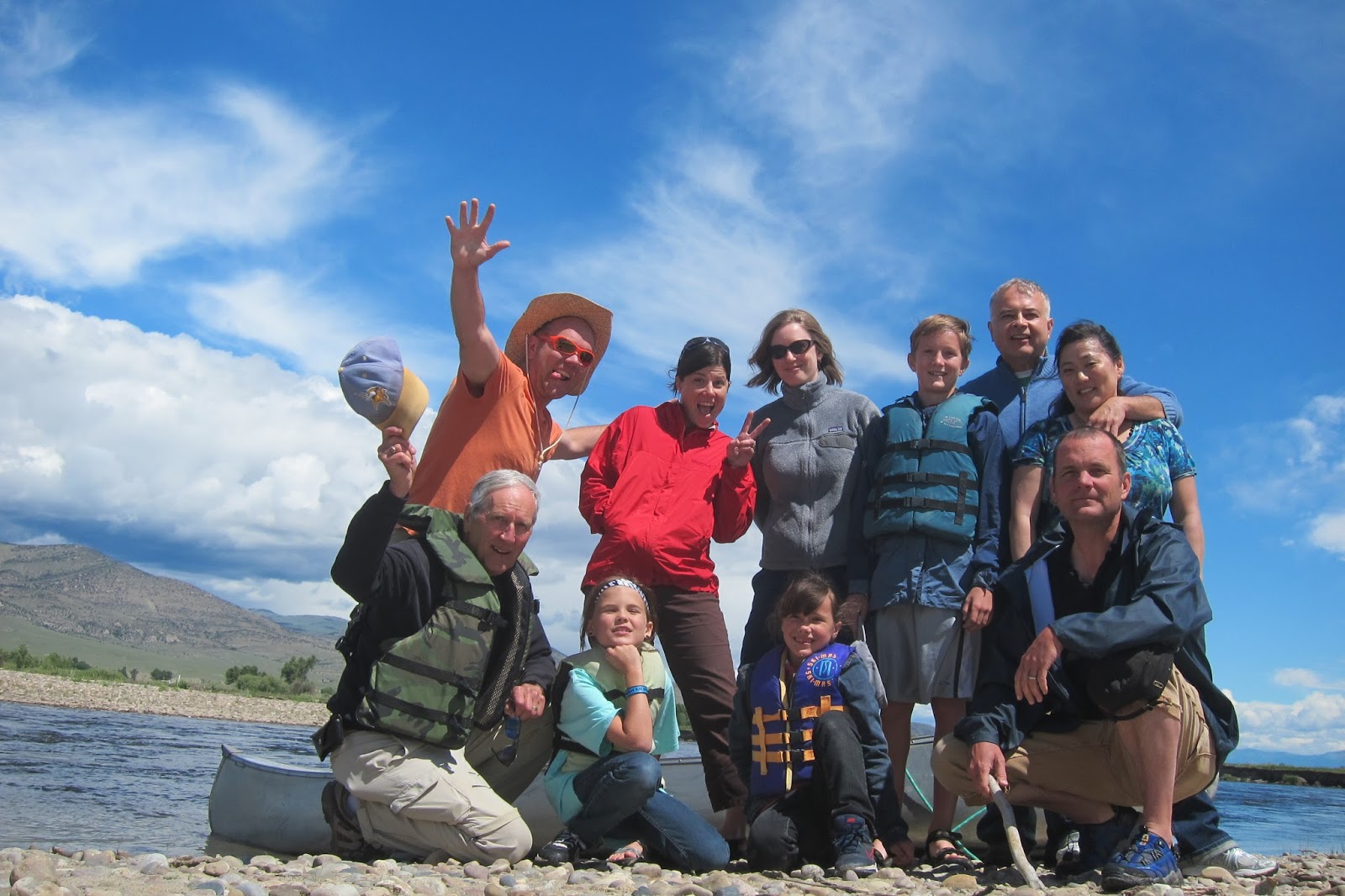
The old beer commercial  that used the phrase "it doesn't get any better than this!" describes the days just passed - days with our family who were visiting here in Montana -  canoeing, biking, hiking, laughing and talking - and even singing and worship together.  And, Oh yes, wonderful food and tasting a great variety of local beers. 


When families get together they inevitably retell old stories and the add new ones.  Thus, the canoe that capsized and spilled Lani, Jessie and Lucy into the fast moving current of the Jefferson River gave them, and all of us, a few minutes of panic and concern - that soon turned to relief and by the end of the day good laughs and now something to reminiscence about.  


I couldn't stop smiling in the midst of the beauty of nature surrounding us. Much joy!  Mountains, rivers and grand-kids will do that to you!

But the days quickly sped by and one by one they left.. though we have  eight year old twins, Frannie and Lucy, and 13 year old Henry with us for some weeks.  

 Judy and I try to enjoy these days, for these too are fleeting.  But we are conscious of the preciousness of each day and give thanks for all these blessings.


Shout for joy to the LORD, all the earth, burst into jubilant song with music;" Psalm 98:4


Saturday, June 15, 2013

Appreciating a Garden


There can be no other occupation like gardening in which, if you were to creep up behind someone at their work, you would find them smiling.  ~Mirabel Osler

These days I spend a lot of time in the garden.... not only mine, but the community garden of  which I am a member.  It's called Jackson's Garden here in Sheridan Montana where I get my hands in the dirt and watch the ever amazing transformation as seeds become beautiful flowers or delicious and healthy food during the summer months.  


I like growing things, but have never mastered all there is to know about it.  Nor do I aspire to.  

Right now we need to transplant the last seedlings from the green house and weed the plants that are already growing.  This week I was doing a lot of weeding.   I found this quote to be true:
"When weeding, the best way to make sure you are removing a weed and not a valuable plant is to pull on it.  If it comes out of the ground easily, it is a valuable plant."  ~Author Unknown.   

Not so true but it brings on a chuckle. There are many poems, sentimental quotes, and sayings about the esthetic and spiritual nature of gardening.  I rather prefer the humorous ones. 

I like the tranquility of the garden in the morning hours.  I don't do any thinking about the problems of the world as I concentrate on the task at hand - tilling, planting, weeding, harvesting. In the coolness of the day I listen to the water rushing down Mill Creek about a hundred yards below. I am aware of the birds singing and one of my co-workers across the way quietly tending to a patch of flowers.  I like the solitude and quiet -  it is a kind of prayer of gratitude.


And another thing about this community garden - all of us are volunteers and do just what we can and want to do - guilt free.  This is pretty conflict free group - which is commendable, given the fact that some do lots more work than others. When I return from a trip I have always been welcomed back, even though the others have been putting in many hours in my absence.  There is a parable somewhere in the Gospels that speaks to this principle, I think.

It is a diverse group of men, women and kids - older and younger, master gardeners and rank armatures, Christians and "nones" - (not affiliated), extraverts and introverts, conservatives and liberals - though we never have gotten into political or religious discussions.  

At the end of the day my back reminds me of what happens when I spend a lot of time bent over the plants I am tending.   As another unknown author said, "Gardening is a matter of your enthusiasm holding up until your back gets used to it." 

Here is a truth about gardening: There is no gardening without humility.  I have never become an expert at it and it doesn't matter. I have many years of experience but have never gained an expertise in plants and soil - though I am glad some have acquired that knowledge and skill.   

 What I appreciate about the garden is that nature comes to life each spring and is ready to surprise us with lavish gifts of life, beauty, and peacefulness - and this prompts me to want to help care for and love this God-given wonder of creation.   

Here is Judy and her sisters in the garden - left to right: Judy, Jackie, Romell, Paula.

Question for reflection:

What is an activity you do that is good for your body, gives you peace of mind, and turns you toward the Divine Presence?

Tuesday, June 4, 2013

Sorting Through and Shedding Stuff: A Spiritual Practice?


Once in awhile Judy and I talk about all the stuff we have and that eventually we will have to get around to downsizing. 

 When we moved from place to place in the past we had opportunities to shed some of our material things, but we usually felt that we still had too much "stuff".   When we came back to the states after living some years in third world countries we would go through a kind of reverse culture shock - we especially remember the vast variety of choices in the supermarkets and the large number of things every family felt they "needed". 

In the 1970s there was much written about the value of a simple life style.  This concern interfaced with the growing consciousness of the vast number of people in the world going hungry and living in poverty.  My perception is that the movement to simplify lives did not catch on in this country. Marketing and consumption are a huge part of our culture.
 
The other day I was looking around the garage and I saw boxes with labels like "Files" and "Miscellaneous".  Looking inside I found many letters, memos, reports, articles and papers that, undoubtedly, at some time we thought were important to keep.  So we neatly filed them away and most of them have never been looked at again.. until now.

I started to look at these files and had an inspiration to sort through and start to shed myself of much of this accumulated paper trail of my life.  As I read some of them I was flooded with good memories, but a few even brought on a tinge of regret for a undue critical comment made in a letter. I mentioned this process of sorting and shedding to dear friends, Paula and Peter Limburg, with whom we worked and shared some of the most memorable years of our lives when we served our respective church organizations in Central America.

Paula sent this perceptive and entertaining commentary on their recent experience:

Dear Jerry and Judy, I read your blog this morning and was so tickled because that is exactly what Peter and I have been doing for the last 2 months! Peter has pulled all print materials from the attic and is almost done in his basement office. We've tossed, recycled, and sorted for shredding tons of STUFF!

Like you, we've been significantly delayed by the distraction of reading whatever it is we're sorting. We have lots of letters from you, and of course from our parents. It must be that when we've moved, we've just transferred boxes and boxes of old letters, college term papers/tests, documents, pictures - they all jog memories that we have to track down in the allies of our brains or ask each other for clarification (usually believing our own take on the memory anyway) - makes for lots of dinner conversations about the past.

I hope that this is just a stage: I love thinking of decades past, but not exclusively! Peter says he's done with the paper-mining, and there will be no more. Hah! This week we "Reune" with my sibs, and in July with Peter's, so I'm returning their letters to them to re-read or dump. Peter's mom saved all our letters to her for several decades, and we got them back when she died. So I've sorted and tossed. Some files will make good memory books when we get hard up for reading - probably never. Then our kids will need to toss.

But it makes us think about life and living and dying - and the significance and meaning of all that we've done with our years. We're so grateful for our faith, and are learning that our worth is not in what we've accomplished, rather what God has (and does) accomplish through us. Otherwise, with our growing collection of frailties and failings, we would have a hard time with finding worth and meaning at this time in our lives when we're not working our heads off - it still is a challenge, though, since our culture tends to define people by their work and their accomplishments. Love to you both, Paula

Now, the spiritual part:  Some of this I got from a Quaker website (wouldn't you know it?)

What Paula wrote is very insightful.  Letting go of what is, in the end, just stuff  - is a spiritual opportunity to live a life of simplicity and stewardship.  It can be an outward act of inward removal of that which is not of God.  It is an occasion of expressing gratitude for the plenty that we have been given, and for receiving the grace inherent in giving to those in need.  It demonstrates to those around us how to live a (simpler?) life, and how to deal with life’s diminishments in a gracious spirit.   

Saturday, May 25, 2013

Thoughts on Generations: Mine and the Next


We spent the last month in Minnesota and Iowa making many visits to long-time friends and family. This year we have been on a sort of mission to see as many old friends and family as possible while we still have the health and stamina for long trips and the luxury of time to travel.  On this trip we saw several dozen friends and family - mostly our age, (give or take ten years), enjoying the kind of conversations one can only share with people who have come through the social and cultural milieu we have traversed together.  If you lived through the sixties you know what I mean!

My generation, those born roughly between 1925 and 1942, has been called the "silent generation"  - sandwiched between the "greatest generation" and the baby boomers.  We were children of the depression.  Almost all of those we saw on this trip grew up on farms or had working class parents who did not go to college, but almost all of us completed college or higher degrees and moved into white collar jobs and achieved relative financial security by the time we retired - though few of us got rich.  We mostly transitioned from small towns to urban settings and most of us followed the values of our parents - especially frugality, loyalty, and our faith traditions.

Tuesday, May 7, 2013

Was It Worth It?


Some years ago I was traveling in the back hill country of Jamaica, visiting the subsistence farmers with whom we had a goat project… a very poor area, though close in miles, far removed culturally and economically from the prosperous resorts on the beaches of Jamaica.

As we came around a corner we happened upon an old stone church which I knew was a Moravian church, because it was the Moravians who had come from Europe as missionaries to the Caribbean several centuries before.  So, I wanted to stop for a visit and learn a bit about this church. 
Inside the church I met an old Jamaican pastor who graciously greeted me and told me about his parish and the people in his flock – very poor people.  After a few minutes he said, “come outside, to the back of the church, - I want to show you something”.  What he showed me were several gravestones with some markings and dates – I don’t remember the details.  But he said, “These were the first Moravian missionaries that came to Jamaica more than 150 years ago. There is a whole family buried here”. 

They came here to bring the good news of the Gospel, but they died within a year or two from malaria – the whole family. They had not established a single congregation… did not accomplish much before they were struck down.  But within a year they were replaced by another family, and the work went on so that today there is a Moravian church throughout the Caribbean.” 
The old pastor looked at me and asked, “What do you think?  What is the meaning of their lives? Was it worth it? Was their sacrifice worth it?”  I did not answer, nor did he give me his.  But his questions stuck with me – and have come back to me many times over the years. I think about these questions now as I look back on life and a long journey of work among the poor in many places. 

Over the last months we have been remembering our time back in a village in Vietnam in the 60s, where Judy and I served with Vietnam Christian Service, spending our first year in the village of DiLinh in the highlands.

If we are honest about it, Judy and I would have to say that we didn’t accomplish much that was lasting in DiLinh.  It was an unstable time, a time of war when the lives on many of the Ko’ho, the mountain people we worked with, were severely disrupted by the bombing and fighting in the mountains in that area. We started the work, had some small projects, Judy worked in the local hospital, a daunting challenge to say the least, and I started a marketing project of local handicrafts. There were some agricultural projects, etc.
One of our successors, Ted Studebaker, of the Church of the Brethren, doing alternative service as a conscientious objector to war, was killed in 1969 when a battle engulfed the village on terrible night and Ted died in the same bedroom we had occupied during our time in DiLinh.  He had only served there for about a year but we heard that the local people had grown to love him for his bright and loving spirit. More recently others have gone back and looked for some evidence of the lasting effect of the work he (and we) did there but have not found many results of what any of us did over the years of that project.  Some might ask, “What did Ted (and we) accomplish?  Was it worth it?”

And this was not the only time I wondered if we were accomplishing much.. We all want to make a difference with our lives --- And so I came to think about that time in the highlands of South Vietnam as a "ministry of presence". Sometimes it is just important to be there.  Many of you know this if you have worked in medical professions or as pastors, social workers, or in our roles as caring members of families and communities.
I suspect that you often found that being with another who is suffering in mind, body or spirit, staying present with those who have suffered loss – being there is what is most needed at the time.  Later when I worked with Lutheran World Relief in South America, we developed a name for that approach - we called it accompaniment.

Looking back, I have no regrets about not accomplishing as much as our programs and organizations sometimes said we did. I do take much pleasure in having worked with organizations whose foundational values were based on the parable of the Good Samaritan. We knew we were to go to and accompany people in their need – we were asked to go and "be there", and see if there was something we could offer. 
So now, perhaps my answer to the old Jamaican pastor is, “Yes, it was worth it then, and still worth it now!”  What do you think?

Sunday, April 21, 2013

Thoughts on parallel tragedies


Tragedy: a medieval narrative poem or tale typically describing the downfall of a great man;  a disastrous event.

Sometimes there is no logical resolution to a tragedy and the story leaves us with deeply felt feelings and questions but few words to explain what we should think or say.  The following is NOT about what happened in Boston this week, but about another of perhaps several tragedies that happened in the same time frame. We pray for healing and peace for all involved in Boston and in Wisconsin.

My sister Jean wrote this from Wisconsin last week. 


Saturday, April 13, 2013

Spirituality and Our Life Stories


Logically, many of the people I have conversations with these days are of my own generation...  former colleagues from my years of work in many places, long time friends, cousins and siblings, and people we meet in the churches we attend and the community in which we now live.  Also it seems to be that, so far at least,  most of those who are reading my book and finding it interesting, are of a mature age. 

I had hoped and perhaps somewhat naively thought that the themes of the book, with stories of service from various places and cultures around the world, might appeal to young people who are exploring careers of service.  But they are busy people, these young ones, and have many other things to read and do.  We have made the book available to some of those who are entering the Young Adults in Global Mission program of the ELCA.  (Lutheran Church)

I do try to communicate with and keep connected with some young people - especially our own kids and grand kids, but we seem to spend a lot of time now with "old people".  Unfortunately there aren't many youth in the churches we visit and relate to, and a common lament we hear is about the diminishing numbers in the churches and the departure of the next generation after ours,  and the next... the generation of our children and grandchildren.